Self-Raising Against Plain, and What Breadcrumbs Are Doing in There
In a steamed pudding batter, flour and breadcrumbs are not interchangeable fillers — each does a different job, and the raising agent question follows from understanding which job is which.
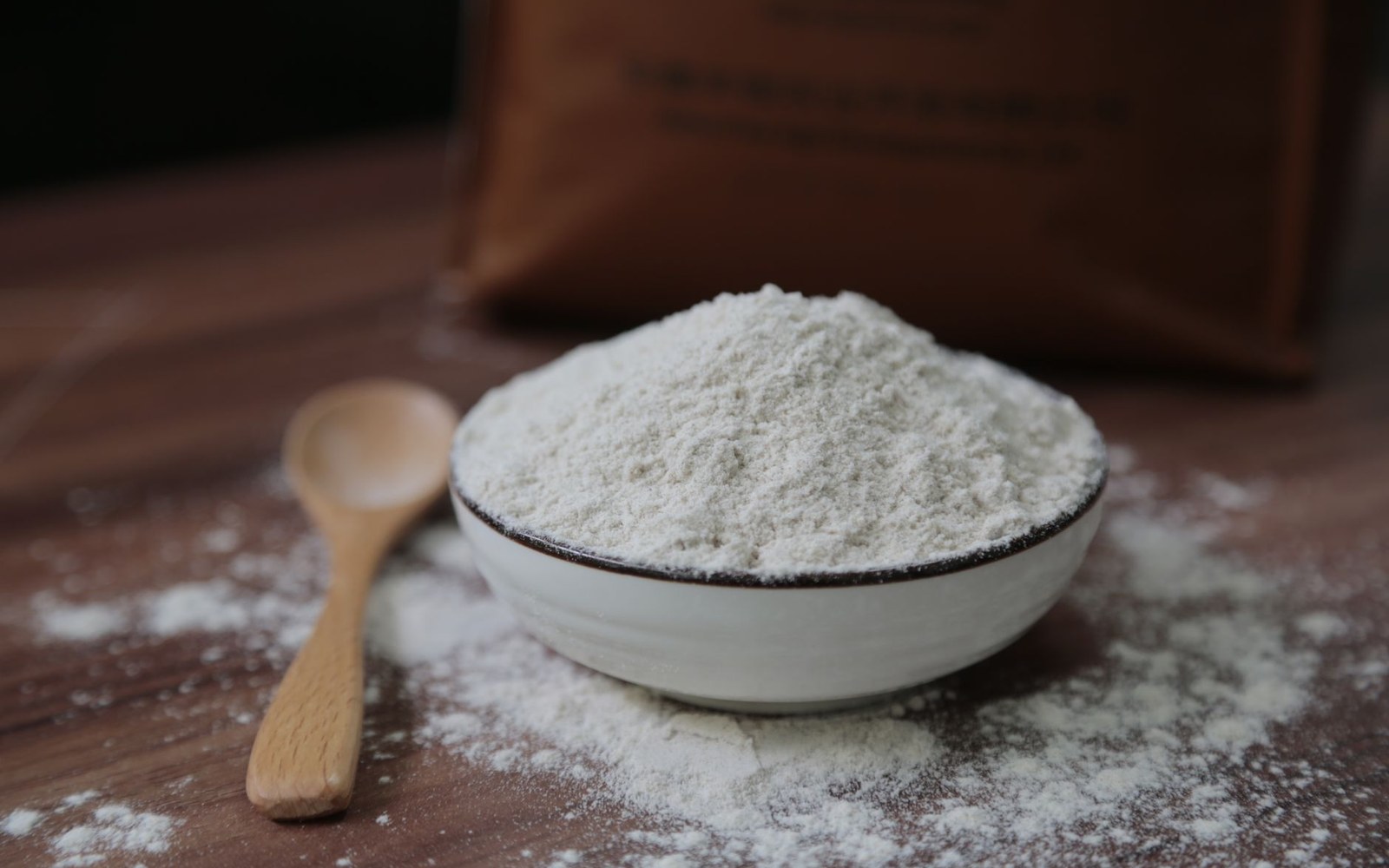
The raising agent question
A steamed pudding lives in a sealed, humid environment for several hours. Unlike a cake in a dry oven, it cannot form a crust, cannot vent steam freely, and cannot rely on rapid surface-setting to hold its rise. The raising agent must therefore work gently and sustain its lift over a long, slow heat rather than producing a quick burst that collapses before the crumb sets. Self-raising flour, which carries baking powder at a fixed ratio of roughly two teaspoons per hundred grams of flour, does this well enough for lighter steamed puddings — a treacle sponge, for instance, where an open, springy crumb is the point.
For Christmas pudding the calculation changes. The batter is loaded with fruit, suet, dark muscovado and black treacle, and the finished texture should be dense and yielding rather than airy. Plain flour with no added raising agent is standard; some recipes include a modest half-teaspoon of baking powder for insurance, but no more. Too much lift and the pudding becomes cakey, the fruit sinks unevenly, and the characteristic close, moist crumb opens up into something closer to a fruit cake. Gluten development is equally restrained: the fat from the suet coats the flour particles before liquid can reach them, limiting the protein networks that would otherwise tighten the crumb.
Baked puddings follow a different logic entirely. In a baked rice pudding there is no flour at all; in a bread-and-butter pudding the structure comes from the egg custard setting around the bread. Where flour does appear in a baked pudding batter — as in a sponge-based pudding finished in a moderate oven — self-raising flour is appropriate because the dry heat sets the surface quickly enough to trap the gas before it escapes.
What the breadcrumbs actually do
Fresh white breadcrumbs appear in Christmas pudding recipes at quantities ranging from roughly equal to the flour weight up to two or three times as much. They are not a filler or an economy measure. Their function is structural and textural, and it is quite specific.
Breadcrumbs absorb the liquid in the batter — eggs, stout, brandy, the moisture released by soaking fruit — and swell during steaming to set into a soft, slightly open lattice within the denser mass. Because the bread is already cooked and its gluten already fixed, the crumbs contribute body without toughening the pudding the way extra flour would. Gluten development in the flour fraction stays low; the breadcrumbs do the structural work instead.
The ratio governs texture at both extremes. A pudding made with more flour than breadcrumbs — or breadcrumbs omitted altogether — is firmer, closer-grained and liable to be stodgy. Increase the breadcrumb proportion toward two or three parts per one of flour and the crumb becomes lighter, more yielding, easier to portion cleanly, and better at holding moisture through the long storage and re-steaming cycle. Isabella Beeton's 1861 Christmas pudding recipe, as recorded in the Book of Household Management, uses breadcrumbs as the primary dry ingredient with flour playing a secondary role — a ratio that remains close to the modern standard.
The crumbs must be fresh, not dried. Dried breadcrumbs have lost most of their absorptive capacity and will produce a grittier, tighter result. A loaf two or three days old, crusts removed and blitzed briefly, gives crumbs with the right open structure. According to food science research published by the Institute of Food Technologists, staling converts gelatinised starch back toward crystalline form, and it is partly this retrogradation that gives day-old crumb its absorbent, slightly dry character — exactly the property a pudding batter needs.
The flour holds the batter together; the breadcrumbs make it worth eating.